
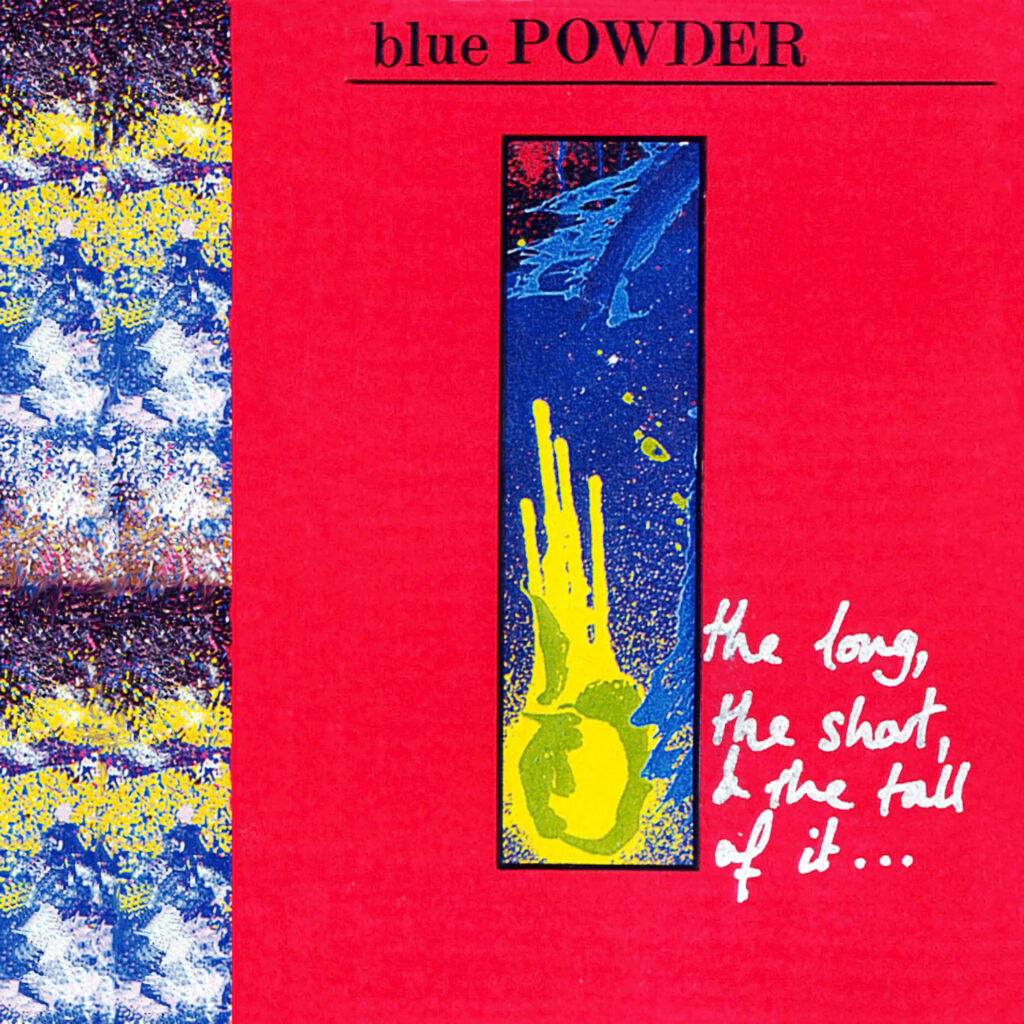
02 – The Long, The Short and The Tall of It
| Steve Chowne | Vocals, Keys, Violin, Flute, Kitchenware | Tush Hamilton | Guitars, Vocals | Clodagh Keane Jo Keizer | Vocals |
| Robin Pomeroy | Guitar, Vocals, Bass, Side Drum | Duncan Jackman | Bass | Chris Green | Sound Engineering |
It’s now 1990, finals year, and we are knuckling down to the delights of deriving skywave reflections from first principles, integrating around the edge of non-uniform planes, and 18th century European literature. Tush is back from his year abroad, and the autumn term is frankly wintry in our modest Regency terrace on the Lower Bristol Road. Following a disastrous choice of student digs in my second year in which the prevailing cold and damp westerly winds ignored the thin glass and rotten frames, and in which the torrential rain regularly made its way through the roof into my bed, we made a much better-informed choice in the third year that was good enough to stay on in into the fourth. Sharon had had enough of us (and indeed had graduated) and Jason moved in to fill the gap. This was a calm and sensible household with dark green woodchip walls, communal eating, and lots of slugs to keep us company at night. The dark green paint was courtesy of our landlord also being a pub landlord, and he happened to have some of that paint left over from doing up his licensed gaff in that 1800s style that was favoured in Bath. I had the room downstairs, so had the biggest interaction with the slugs, but we mostly got on fine. The Golden Fleece was about 2 minutes’ walk across the A36, and we finished our evening’s study there pretty much daily. This was a local’s local in Twerton – one of the less poncy bits of Bath, and very handy for Bristol Rovers’ ground, whose floodlights regularly lit up our modest yard at night, cheering on our closing time pint. The walk into Bath proper was only about 20 minutes, and unusually for Bath, the route flat as it followed the industrialised bit of the Avon. We may have been on the far side of town, but it still rained consistently here.
After the phenomenal success of Plastic Surgery, we were on a roll. No-one had summoned up the courage to tell us to our faces that what we had was completely crap, and so we were arrogantly encouraged by the vacuum of feedback to press on with our bit of fun on the side of getting our degrees. We hadn’t been weighed down by any commercial imperative or interfering investor demanding a return on their money, so we remained free to do as we pleased, whenever we chose, any old time. None of us were under the illusion that doing another album was going to get in the way of our future high-flying careers in life-saving pharmacology, interplanetary science and translating for world leaders. It was just going to be a bit of fun.
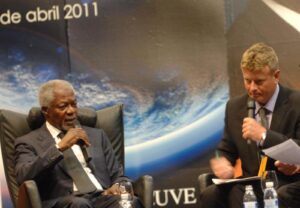
Kofi Annan and Tush doing Karaoke
In spite of having a much more compact cast list, The Long, The Short and The Tall of It is much more of a team effort than Plastic Surgery. With Tush back in the country, we were able to co-write a far greater proportion of the material, and the result is a far more consistent style of recording from end to end. This team effort also gave room for Robin P to offer his own composition For A Time: this was the first original material we did that that I hadn’t had a hand in writing, and it fits in so well that I sometimes have to stop myself from taking the composition credit.
Being finals year, we pretty much stopped playing live to allow us all to focus on the studies that justified our presence at uni in the first place. This was cemented once Gavin dropped out as we were missing a drummer. It was OK – the recording project was enough to keep the itch scratched whilst the exams loomed ever nearer. It meant that Chris and I could patch together the material and tracks as and when people were available to contribute. The technique was again to stuff the players into the University Radio studios late at night, having put together various bits and bobs using the 4-Track as essential backing material (like hitting kitchenware to get that magnificent home-made percussion sound). The outputs were again mastered by Chris and his scalpel, but this time there was a much bigger focus on organising structure around a “live studio performance” when compared to Plastic Surgery, which was far more about seeing what more trickery we could squeeze in, regardless of whether it produced a quality output.
I had my own scalpel to produce the artwork this time. This is, I understand, a really famous bit of modern art. Cut from a reproduction in a weekend glossy, and subjected to a casual bit of original collage, I am ashamed to be unable to name the original artist, but the handwriting is mine.
The songs reflect that we were a little bit older, but still not overflowing with the wisdom of years. The opener, Breaking Out, was written at Tush’s place. It’s another one of those instances where I sat with a pad and pen, waiting for lyrical inspiration, whilst listening to him jam randomly for a bit. Out of nowhere, this riff emerged: da naa-na, da naa aa-na and it triggered something that made me write down “breaking out”. I didn’t have anything else at that point, so I ran with the two words:
“Break-ing ou-i-ou-i-ou-ou-ou-i-ou-i-ou-ou-out” etc.
It’s really odd how these things happen sometimes. It might be a chord, or a rhythm, an interval or a combination. In later instances, I have taken riffs, notes, samples, and established tracks from Tush, and worked them into songs. I don’t know how or why it works when it does, but when it does, it’s been a joy to create something from that tiny spark. It’s usually also a shortcut to something, although not always something we comfortably agree on. There are several versions of output in our respective catalogues downstream grown from the same seed, but with quite different results. I guess that’s the contribution of each of nature and nurture.
| Breaking Out |
| Breaking out of your world Breaking out of your soul Leaving all the things that you cannot stand behind Leaving all the things that you want to leave behind Cos there are so many people doing just the same In this big wide world, going all the way And if you want to leave then just get up and go Sod the World, get out there on your own Break out, sod the world Walk out, sod the world Run out, sod the world Scream out Walk out today you can leave all the rest You can do you want you can be what they call selfish Now |
So, Breaking Out of what? Self-imposed boundaries. I should listen to myself more and ignore a few conventions that have been stifling or steering me in unhealthy ways over the last few years. It’s fair to say that this self-help anthem has been thoroughly unsuccessful in convincing even its author, but we really enjoyed getting those chorus vocals together in double thirds. If Gavin hadn’t done a runner, I think this would have been improved with a banging drum track and thumping bass, but it wasn’t to be. Robin did a fab job with the one snare we could get our hands on at the time, and this provided a much-needed pulse. Tush’s low register guitar bashing allowed us to largely get away without the thumping bass.
If, however, I were to re-record, I’d do it slightly more conventionally and I think it could be an absolute ringer.
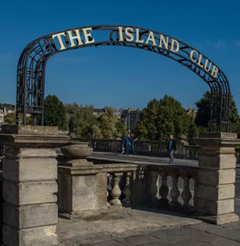
Photo Bath Chronicle, Paul Gillis
To explain the idea behind track 2, Wonder, requires some understanding of a local quirk of Bath. Until the 1970s, there was a rather stinky public toilet at the junction of Terrace Walk and North Parade. Above the since-revamped Parade Gardens, this feature of municipal usefulness fell in disrepair, and the council then sold it off. It was “done up” and opened as the Island Club, and forever known locally as Bog Island. One entered from the same public toilet steps above unto an unconvincing sanctuary that continued to sell entertainment and alcohol after the pubs shut. It was appallingly ventilated, and so excruciatingly damp that I suspect the beer they sold was at last half made of water dripping from the black ceilings.
Having been introduced to Bog Island in Freshers’ Week, it took me about a year to grow sufficiently confident to say to my friends that I wasn’t going back. This decision did however give me the moral (and literal) high ground to look down upon those still immature enough to queue up in rain for entry to the place, and to then write a song about it. Having grown out of it, I could aloofly wonder why those young people were still at it given how awful it was.
It’s just as well I wasn’t an English student. I can’t imagine how arrogant I could have been if I’d read more of those terribly worthy but fortunately inaccessible classics.
This is a track where the words came first. It’s also one of those very rare occasions where I persuaded Tush to sing and caught him on record doing so. I still don’t know why he’s so shy about it, because I think this works really well with him and me counterpointing and then harmonising together. This song is just the two of us: he did all the guitars and bass on top of my piano starter and I added the violins afterwards. Huge thanks to Richard for the loan of the digital piano for this and the next track. I’d never had my hands on such a thing before and it was an absolute joy to be able to play a digital instrument with real touch-sensitivity and weighted keys. This was a million miles away from my Stage 73, and I didn’t want to stop playing it. It would be many years before I could afford to own one of my own, so I made the most of it on this album, choosing a particularly percussive voice for this track to obviate the need for a rhythm track of its own.
| Wonder |
| It’s the morning after A night at the Bog And my head keeps spinning around In this self-contained fog And the morning’s shining Light in my eyes And I wonder… Why do we do it? Why do we go? It’s the morning after Six pints in a row And the lights keep flashing As the ceiling’s dripping While my head beats so And there’s blue sky shining Light in my eyes And I wonder I see pictures of a thousand people Running around in a sea of sweat Shoving and jostling one another While there’s drinks to get I see pictures of a thousand strangers Hoping to find the one they need There’s couples on the floor getting closer To another one-night stand |
Armed with this wonderful piano, I flexed my fingers I wrote my first genuine love song, Letting Go. This is pretty raw and whilst it may in practice be not quite as obvious as perhaps intended, it’s as emotionally open as I’d ever got in songwriting. I’ve regularly been described as analytical, cautious, and not much of a risk taker, and yet, contrary to these reasonable and fair character assassinations, I got engaged as a 21-year-old student. My future father-in-law was initially horrified and jumped to the immediate, unintended and incorrect conclusion that our proposal implied an urgency. A minute later, after suitable placation, we were all back on the same page, the ambulance cancelled, and everyone reassured that there was plenty of time for us to plan (and save) for a classy reception as we all had to graduate, start working and find somewhere to live first. Little things…
Getting engaged was a positive and joyous thing to share together and with everyone else. It’s one of those high points in my life, so unsurprisingly, this is not the only song in the catalogue that the event has inspired. Evaluating it introspectively, I clearly recognised I was also letting go of a shedload of the past and letting go of a fistful of inhibitions that I’d been carefully nurturing since starting on the journey to work out who I was. Ultimately, however, this is a love song, because of the choice to give things up – to let go – for someone else. It was absolutely the right decision.
| Letting Go |
| The radio was blaring It’s My Life Stirring shallow thoughts of whose it really was Whether anything I could think Could change the way that was Fate for a better word Words for a better sword Thoughts for a better life. So I sit with my head engaged What of immediate future What about a means to an end Long term plans with degree in hand? Still making paper planes Still junction hopping lanes On a ring road with no end in sight Of a guiding light It’s my life and I’m in control Oh I’m letting Oh I’m letting go It’s a funny way of saying so But I guess I’m singing you a love song So here I sit with my heart in your hands Talking well past time Suggesting that it’s now our lives Where I am yours and you are mine It’s mutually amenable agreement That surpasses tactful appeasement Can’t say it any way other than that I know I guess I’m singing you a love song |
For A Time was Robin P’s composition. He’d recorded it before, and suggested we put the Blue Powder spin on it and incorporate it into the album. Robin’s previous EP was shared around, and we all agreed it was both a good song, and that we could do something similar but new on it. Much to his surprise, I encouraged him to sing lead, and let me improvise a backing vocal of mainly thirds and sixths. This vocal collaboration was never written down – we just went for it until it worked. This is one of those songs that was effectively a live recording of us playing together and I really like the way in which it adds another angle without jarring the gentle vibe the album was working up.
I got myself a job behind the bar at The Ale House in my first year at uni and became one of the regular bartenders in both the sticky downstairs cellar haunt of unruly students, and the much more compact saloon upstairs. Whilst the upstairs bar occasionally let the odd tourist in, it never really welcomed them, because every seat was allocated and taken by regulars who lived and worked in the city, and who drank away their problems in the bar. We enjoyed a rainbow collection of characters worthy of an Agatha Christie novel. Geoff was drinking at least ten-pints of Directors a day alongside his stinking square cigars. Alan (half mild, half bitter) wore his Badgerline Bus uniform in every night; Alan wasn’t actually a bus driver. Louise had allegedly been a model (maybe like fifty years earlier?) but now suffered such terrible agoraphobia that she could not leave her flat ten doors away, unless she’d run out of gin or fags. Louise did a great line in trying to hide her requests for another large gin in her crisp-lined wine goblet, but her jolly husband Mike just casually ignored it all night until the moment she would reliably fall backwards off her barstool with a gentle and inelegant slither.

And then there was Julian, Roland Orzabal’s brother. Not exactly a regular, but you noticed when he came in. Roland was one half of the famous and successful Bath duo Tears For Fears. From behind the bar, I sometimes saw the younger and somewhat less famous of the two come in seeking attention. One particular event involved him swinging open the door, strutting in and picking out Everybody Wants to Rule The World unconvincingly on a battered old acoustic guitar. He looked to the small assembly for adulation. It didn’t come, and nearly forty years on, I still cringe. In his favour, I know nothing else about him, and don’t want to.
I am much more familiar with the Tears For Fears catalogue, which still features in my playlists today. Songs From the Big Chair was very much a thing at the time, and I recall The Working Hour was the piano-driven piece which inspired me to write our next track, Shufflesong. They have practically nothing in common, although it’s always a bit of a guilty secret to admit what was going around your head when inspired to write. The lyric is a bit contrived, and whilst it sounds today like the immature student poetry that it is, the subject
| Shufflesong |
| There’s a woman walking down our street And she is lonely you can hear it in her feet Shuffling along with her worldly goods in hand With her half price shawl from the second-hand man And she is struck by the sound of distant laughter It’s the closest she gets to being disturbed By a friendly sound on another street corner By a human sound in her selfish little world Shuffling along and the wind is getting harder Shuffling along and it has started to rain Shuffling along and the voice is getting louder Telling her to end the sorrow, to end the pain Grey banks roll up with whispers of silence As the first drops fall a leaden sky She wraps her head tightly in a Gateway carrier Wincing at the hurt of trying not to cry Well, she has dirt in her eyes it’s the obvious answer The soup van passes, and she fades into the night The wheels spray her darkly with the muck from the gutter But it doesn’t really matter, she is just a parasite Well there’s a woman sitting in the park Discomforted by silence and yet blanketed by dark Methylated spirits help to keep the warm inside her Dimming her eyes which helps her not to see them burn Sitting on a swing rocking backwards and forwards She’s allowed there now with her mental age of four She prays to a God that she’s heard lives in Heaven Hoping to Hell that he will open his door There’s man with a job, he’s the municipal gardener And it is his job to try and keep the park clean With reverence he bows to the woman in the playground With reverence he sweeps away the path of where she’s been. |
Since posting on the subsequently invented internet, a thing we didn’t think about much when writing song titles, the catchily monikered (I Need You Like A) Frontal Lobotomy is one of those tracks that seems to have more regularly caught the attention of the casual browser. I’d say you couldn’t write this stuff and yet with my tongue firmly in my cheek I obviously did. It was one the tracks we’d done live a few times and it had always landed quite well as long as the lyrics were suitably articulated and audible above the band. Learning from this, we kept the instrumentation to something simple – the sort of stuff that might just find laying around that average home – and recorded ourselves beating out the supplemental percussion track with bamboo chopsticks on the assorted pots and pans and lids and trays that made up our high-quality kit. (I Need You Like A) Frontal Lobotomy was very much born and developed in the bit of my head that attempts to see things from another’s perception because it really isn’t about me and my relationships. This jolly acerbity probably came from listening to the rather excellent Mind Bomb by The The rather loud and rather late (as per
Matt Jonson’s recommendations). Musically I think these again have absolutely nothing in common, but there was something in his lyrics which twanged my cynical core and this darkness spewed out as a result. The quirky production is probably just trying to hide what it’s saying and where it came from.
| (I need you like a) Frontal Lobotomy |
| I need you like a frontal lobotomy You bore me to tears I need you like hyena’s cacophony You’re killing my ears We’ve given each other all that we’ve got In the surge of semen and the stench of blood clot You were a bed to lie in, me an ear to bend Me a bed to lie in, you an ear to bend Now we’re drawing together, it’s time to end I need you like a motorway contraflow When I’m going away I need you like a cistern overflow You wash out my day We’ve given each other all that we could want With the surge of passion in the heat of what we’ve got I don’t need you You’re like a frontal… you’re brutal |
The next song is about a rubber doll and has absolutely nothing to do with my very lovely Aunty Sally (who absolutely hates me calling her Aunty). Hot on the heels of Frontal Lobotomy, it’s safe to say that this song is not born of personal experience, and the only recollection I have after all these years of why it was written in the first place is because of some daft comedy routine that we witnessed, and maybe one of Tush’s friends having a plastic companion. Clearly whatever it was wasn’t sufficiently funny to remember. Again, that falsetto is a great demonstration of what you can do when you are young and what you lose over the next few decades. It’s all so very daft but presented against a charmingly gentle Latin beat that is a quiet opportunity to show how good a guitarist Tush is without being all showy.
| Sally | EXPLICIT |
| Oh I’m in love with Sally She listens to me every night She’s five foot two Her eyes are blue She takes my breath alright To the early hours She never answers back ‘Til the morning When I go to work She’s in the bottom of my drawer Just waiting She won’t clean the house She’s quiet as a mouse She leaves my breath just baiting Like a man trap When I hit the sack After a hard day’s working With a bottle of aspirin | Sally is my friend She’s highly understated In the middle of the night Her ego gets deflated So I get back to the job On my hands and knees Believing that she breathes Or I’d go crazy She spends the day alone And always stays up waiting in my old grey mac Hair long and black She’s calculating like a man-trap When I hit the sack After a hard day’s working When I grow up I wanna be with Sally Lonely days with her inanimate ways I know she’ll never leave me In the morning when she takes a bath all day I hope I work I pray that she’s replaceable She’s so delectable She’s unforgettable She’s really loveable Entirely wonderful So utterly fuckable |
Seizure (On the Motorway) on the other hand is a genuine folk song narrative retelling the dramatic truth. I bought my first car from my future wife for £50. A genuine bit of a bargain, and I somehow kept it on the road throughout most of my college years with a mixture of fibreglass, underseal and a great deal of help from my more mechanically minded friend s, like Andy, who just loved getting greasy. I only once fell foul financially, going begging to my parents for a couple of hundred quid when the bottom ball joint fell out of the suspension as I was backing out the yard. But that Texas Yellow VW Beetle was a great, if smelly and damp, car. It carried all of us around, got us up and down to lectures, and we were young enough to not really care too much about the fact it was full of carbon monoxide because the window winders and heater still worked. In true student fashion, Jermain (as he was christened) was customised with a unique paint job, which meant he never got nicked. The diver’s side was artfully fashioned in a jungle scene (yes, Jungle Jermain) with palm trees, rocks, waterfall, and various flora and fauna. The passenger side was a dubious interpretation of Monte Carlo and its waterfront. I have no idea why … it was just creative and a bit hippy.
| Seizure On The Motorway |
| Seizure on the motorway Stuck, cocooned in car Engine’s burning, I’m on fire Don’t think I’m going far Tonight Always thought that I would make it Never thought I’d get stuck here All my friends are passing by me I see my future looking clear Tonight Cos I’m grounded I’m stranded I’m on a hard shoulder And I have nothing to cry on Tonight |
I drove that car all over, racking up many miles between the various establishments my course sponsor wanted me to work at. Over the final placement summer, I was driving my wonderful old banger down towards Rochester in Kent. Pootling along as the M26 joins the M20, gently rolling downhill, I could feel the car sputtering and losing oomph. A mile later, and I was adequately convinced that this wasn’t a small nugget of dirt in the pipeline that would blow itself through; it was persistent and worsening. Yep … temperature gauge was a bit high, so I pulled over to the hard shoulder and opened up the back (because the engine is in the back in a Beetle). It was clearly hot. Now, Beetles have no radiator – they are air-cooled. That’s why they sound like motorbikes, and
why our batty old neighbour in Bath kept reporting us to the Council for having loads of bikers visiting when we didn’t. All I could do was let it cool down. I doused the whole thing in cooling oil, and sometime later, topped up the inside of the engine cavity. Lesson learned? Well certainly material for a song, and the car lived on to be sold at a hefty profit many years (one refurbished engine, and one more sober paint job) later.
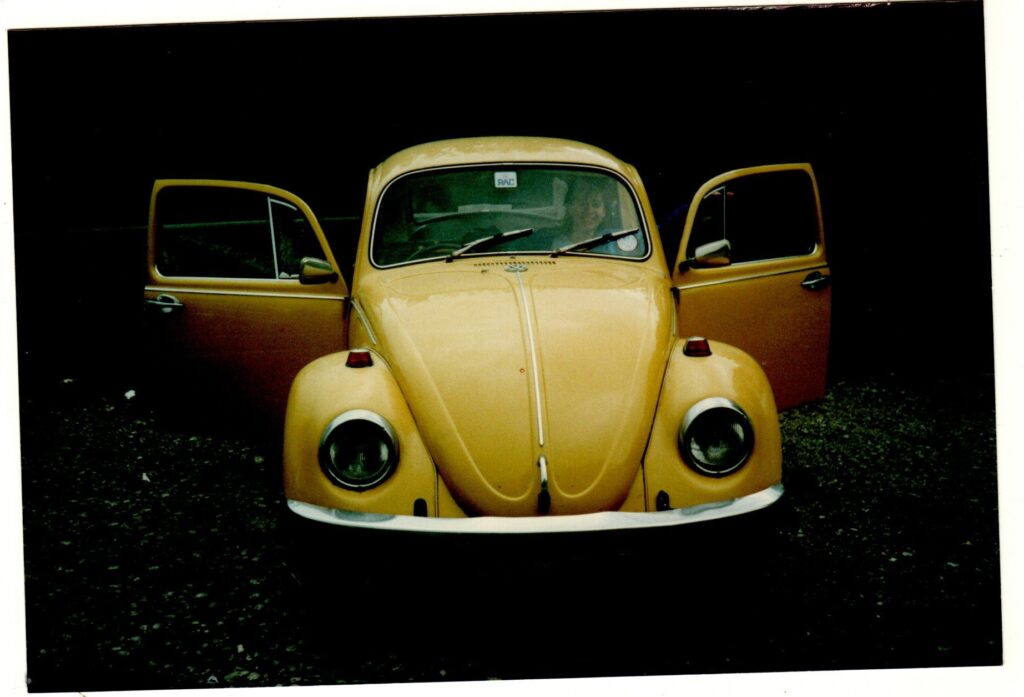
(still nude at this stage)
I’ve never quite fathomed why, but Stagestruck is another of those song titles that seems to have attracted a greater share of casual browser hits since all the material was posted online. There has never been quite enough traffic to put it down to momentum or popularity as such, so I have always inferred that it must be something to do with the name itself. It’s a bit of a poem that Tush and I co-wrote, and I think it was always clear from the off that I wanted a good clear voice other than mine to take or at least share the lead on this. It’s both folky and mesmeric, doing very little harmonically, but then folky stuff doesn’t. The repetitive thrumming rhythm lends itself to room for soloing and so this was the space for each of us to twist and turn a bit around each other on guitar and flute. There was no template or design… we just let it happen, and then returned back to the verse again to close out. I think our friend in Ladbroke Grove probably detested this, but I think it’s picked up many repeat plays online because of its laid-back simplicity and collective approach.
| Stagestruck |
| Another night under the lights That seem to shine inside of me And all the thousand, thousand eyes They try to look inside of me I’m stagestruck Another night under the gaze Of a hall of strangers And we all bathe in the crowd’s applause As they pay our wages I’m stagestruck I believe the audience is clapping I believe the audience is rapturing I believe the audience is leaving now I believe the audience is staying tonight Another night in a dingy club That seems to be like my very soul Mixed up inside but it doesn’t show My only chance of being whole Of being whole |
Acapella Song should of course be A Cappella Song, but I hadn’t actually studied any Italian at that point. Ho studiato un po’, ora.
The premise is obvious, and the lyric is so meta it should probably be shot. If it were recorded today, autotune and autotimer would intervene, and the effect would be much crisper and to the point. A producer might also intervene and edit out the dubious beatboxing: it’s like a white-guy rapping – but more about that on Sheer…
| Acapella Song |
| For many years I’ve tried to write A song with all the instruments gone So here it is now after so many years An attempt at an a capella song Well met 4 years back in a grocery store Shook our hands, brushed our knees and knelt on the floor Well one began to sing and the others joined in When the Grocer man showed us the door Oh, sing in the morning, sing through the day Sing for the evening, Let our voices show you the way We went down to the subway and we stood in line And we all just started to sing The harmonies were flowing and our feet were in time And the new world began to being A crowd of people stood and watched with awe As the bond between us grew into the night The tongues were rising up like a ball of smoke And the words we sang shone out our their own light The train approached the platform so our voices grew The crescendo drowning the sound The people disembarking overcome with joy And they threw themselves to the ground Well a man nearby he started to pray And his eyes were filled with tears His chest heaved so and his voice was found And he sang out thousands of years A thousand voices sang as one |
The closing track is so named because it was the first thing that Tush and I wrote for the album. Having penned it, we agreed it was an album closer.
There are many oohs and aahs, and little meaningful content in the lyric other than to identify that we both believed in the power of the amoeba. Darwin (see later) would be proud.
| First and Last |
| We believe in a new day We believe in a change in the weather Throw away your masquerade And step down from your mighty stage I just want to be there I just want to see her I just want to be an amoeba |
I’ve always recognised that there are two types of song lyrics: those that are meaningful, poetic and trying to communicate a message from author to audience in a bizarrely constraining medium that may demand rhymes or metre or other artificial limitation to make that meaning increasingly obscure; and those that just use words or sounds as another instrument, whether it makes sense or not. First and Last is one of the latter, so there is no point analysing further.