
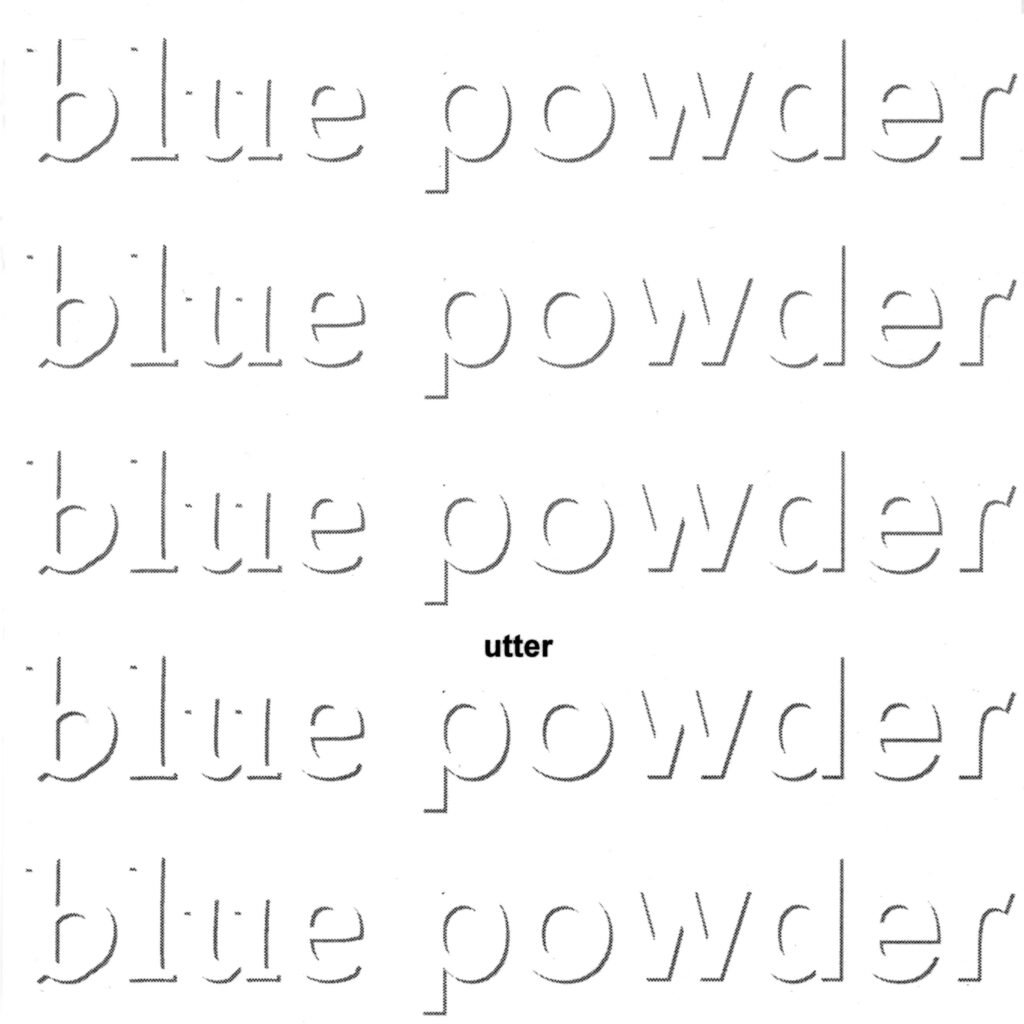
04 – Utter
| Steve Chowne | Vocals, Keys | Tush Hamilton | Guitars |
| Elaine McCormac | Guest Vocals | Chris Green | Sound Engineering |
We’ve left Kent behind, lost a shedload of money on our first house, and upsized a bit into the cheap end of Surrey where I have a new job. Redhill came into existence as a railway junction at the point where the London-Brighton tracks meet the East-West lines. The route could have gone to Reigate – a real place with centuries of history, but the town toffs didn’t want any of that nasty, smelly train stuff in their posh place. Whilst Reigate prices still inexplicable have a 20% premium on Redhill prices to this day, it takes them another half an hour to get to work because of this nineteenth century short-sightedness. How we laughed all the way back from the estate agents. Ha ha ha.
The beauty of Redhill is not the town itself, but where it sits. It marks the south end of the natural pass through the North Downs straight out of London and as such it is on the edge of an AONB. Far too many of its residents are too face down to notice, but the walks, rides, views and air are something to be jealous of. It doesn’t rival the Peak District, but it’s a damned sight more accessible. Within a few minutes on a bicycle from my house in any direction, I’m in open country, and have the choice of flat, muddy, hilly, wooden, lakes, and wilderness. The views along the North Downs, out to Leith Hill, and down from Newlands Corner are spectacular in all seasons. I’ll not oversell it: the high street is as uninspiring as the post-market debris that flies around like urban tumbleweed.
Tush is in the process of relocating to Cordoba in the hot interior of Spain, Chris has a place in darkest Wiltshire, Jo is I think somewhere in Russia, Clodagh up North, and Duncan has disappeared. In fact, it turns out that Duncan is working about a mile from my new house, but I don’t find that out for years. It may be a small world, but not small enough. The internet has only just come into existence, and we haven’t really worked out what it is yet.
I have no band and am not part of any music making organisation or club. The itch is still itchy. I do have a piano, a guitar and bass, pen and paper, and set about writing some further material. It is at this point that I buy myself a new toy – a second hand Korg M1. This is radical – it has a built-in sequencer which I can immediately overcomplicate things with.

I remember reading various articles about Peter Gabriel and the making of his fourth eponymous solo album which came out whilst I was still at school. I didn’t pick up on any of his stuff until I was living round the corner from him as a student, but the point is he was experimenting with the art of the possible with the programming of the Fairlight synth. Despite having a somewhat smaller screen, I think the M1 was somewhat easier to get into. For a start, it gave the user a load of preset sounds ranging from tinny strings, through a reasonable piano and unconvincing wind and brass, to genuine electronica you couldn’t argue with. What’s more, you had full control over all the parameters that shaped those sounds, their samples and their envelopes, their AM and FM modulation, and their response to the touch sensitivity of the very plastic keyboard. And it had some wobble controllers too. I’d never had such a playground.
But it was the sequencer that really caught my imagination. This was a bit of the machine that allowed me to pre-programme a sequence of notes that the computer then played on my behalf. It’s a bit like the looping pedal that Ed Sheeran uses in his one-man show, but a lot more flexible because you can vary every loop. You can define song structure and have loads of different synth tracks going in parallel. The main drawback of this system is keeping it all in your head because there is nothing to see. You can plan on pencil and paper, or just run with it until it works, which is what I did. Kind of like a very slowly evolving jazz with the ultimate in quantization.

Like so much sequenced music, the timing accuracy is astoundingly good because it’s the computer that’s playing so much of it. You can add expression to your heart’s content, but that quantize option is addictive…. The synth always plays in tune, and with the touch of button it always plays in time too. The consequence is a loss of feeling or musicality. Just compare punk with the synth pop of the early 80s and you quickly get the idea of what’s missing when you let the technology take too much control. The most successful and enduring of those synth poppers are those with the really expressive voices, like Alison Moyet rather than Howard Jones.
Frustration was written in the run up the general election towards the end of Major’s first term as PM. No-one expected him to get in again, and the furore in the media and commons was both exciting are ridiculous. As a spectator of the debacle unfolding, and a voter who was now working, I felt enormously disempowered by the nonsense going on in both the political and journalism professions. I was hugely frustrated to be unrepresented by either my local idiot MP, who was a bit of right-wing nutter, and frankly everyone else in the house who was more interested in themselves than representing me, my family or friends. Print, radio and TV hacks were no better – they all seemed to have their own agendas that were as transparent as new cling film. The only person I actually had any sympathy for was John Major, and I wasn’t even voting for him.
| Frustration |
| Don’t blame me for this frustration Don’t blame me for this sad nation What more can you expect from a man who lives his life in the woods? What else can you suggest to a man who only wishes he could? What else do you expect to hear from the mouth of a politician? What else can you suggest to the ears of an unimpressed statistician? It’s a long way when you’re coming down Did you really believe all the things that he said at the start of the year? Did you really accede to the lies that he said just to get you to hear? Just how much of this crap does it take to start to get you to see? Just how much of the lie has there got the break over me? It’s a long way when you’re coming down There goes another one back on the bench and they call him a casualty There go another ten back on the bench and they lapse into anarchy Why is it both sides are equally full of the crud the electorate hate How come adults slinging mud at each other is laughably called a debate? |
I wrote the lyrics and played/programmed the track into the M1 sequencer which gave me a massive production capacity extension to Freddy the 4-Track. Essentially, I now had squeezed almost all the band into the sequencer – drums, bass, keys, funny noises – the lot. This meant that the 4-Track and mix down could be reserved for clean and un-bounced captured of vocals and guitar. I asked Jason’s better half Elaine to guest on backing vocals for this, and she gave a lovely performance that frankly I screwed up the recording of. Chris was not available to record these vocals, I think possibly for the first time ever, and it shows. I should have captured her in much more definition and clarity than I managed.
The process for the rest of the track is the same as for the rest of the album – sequencer, my semi-finished vocal – then bring in Tush to add another layer of musicality on the guitar before final mix. Utter has a bit of a sterile feel to it because of overreliance on the new-to-me sequencer technology. Fortunately, Tush’s extra layers – just playing on top according to what comes to mind – is really what saves this from being the worst Pet Shop Boys album that was never made.
The second song, Cheaters is another expression of frustration targeted against those in power. I’d been out in the big wide world of work for a couple of years by this point and was already jaded and disillusioned by the corruption of corporations, and the massive hamster wheel on which we were encouraged to run our rat race. I guess I’d had a head start by being sponsored through university, but by this point I could see that there was substantial difference between what I put in, and what I got back from the system, and that my employer was taking the mick at my expense. Sure, promotion, opportunity etc. etc., but who was getting the value of the revenue I was generating? The song lyric is a bit broader brush in terms of its aim, having a general go at the misuse of power by anyone who has it, whilst they pretend to nothing other than beneficent.
| Cheaters |
| Cheaters – every one of them, cheaters Using their coats to hide in what they destroy Blissfully aware of what they deploy Playing the green card to see they collect The power that’s free with the will to protect Priest playing God in his ivory pulpit Trailing the choirboys thoughtfully provided Marketers selling pictures of hope Coffee that tastes of American soap It’s fun lying to a world that wants to hear It’s fun being the one they want to be near It’s fun cheering with a crowd that wants to cheer It’s fun to the point when the truth is coming near But it’s too late once the cheater is in Cheaters – every one of them, cheaters He’s beating his wife for playing the field When he’s doing the same for the last seven years Insurers that cover all that you own Except for the fire that guts your home Dance bands playing their innovation Sampled from tapes of the radio station A microwave meal that’s ready in minutes With a cumulative taste that’s worse than what’s in it |
The sequencing on this track is clearly inspired by Peter Gabriel’s San Jacinto. It has that same floaty pipe vibe that runs through it, combined with a bit of a monologue voiceover. Due respect to Mr G.
Peter Gabriel wasn’t the only thing I was listening to. I had by now acquired the marvellous modern technology of the Compact Disc player, and even had a few Compact Discs to play on it. One such early disc was by a relatively small band from Ireland called U2. I’d seen them at Wembley Stadium a few years earlier as a result of housemate Steve’s enthusiasm, and I admit that Bono was extremely skilled at working a big crowd. In the same way I had learned to appreciate some hard man’s music by room sharing with Richard in Bath, I also incorporated a number of other things into my listening repertoire courtesy of my other friends. U2 fall into this category.

Photo by Pop & Zebra
Their song, One, isn’t bad. It was good enough to inspire me to write Power. In reality the only thing in the U2 song which is relevant is the reference to playing at being God, which I think lurks as a bit of a throw away in the second verse. It picked this up and made it the main riff in the tune of Power. It’s not a religious song. It’s just a swipe at narcissistic megalomaniacs, and their impact on the small guy with lower self-esteem. With due reverence, I asked Elaine to take the lead on the vocal….
| Power |
| Do you wanna play at being Jesus? Do you wanna play at being God for a day? Do you wanna play at being Budda? Do you want the power; do you want to be obeyed? What if I had a million dollars I could make my mark on the world What if I was the bravest I could always get the girl What if I was the champion I wouldn’t need to fight anymore What if I was in power I wouldn’t need to worry anymore |
It gets a bit more personal now.
Over Christmas dinner, my grandfather grew ill. Within the week, he was in Brighton General, and diagnosed with terminal cancer. If that wasn’t enough to make for a great family Christmas, it quickly became very clear how well he had been successfully hiding the extent of my grandmother’s Alzheimer’s. Without him at home, she was reduced to cowering behind the front door with a kitchen knife and was sectioned within hours for the rest of her life.
I witnessed the shame, embarrassment, guilt, and above all, love expressed by my dying grandfather as he rapidly withered away in the next few days. Sure, she was nuts, but he still loved her. I don’t think I’d ever seen anything quite like it.
| Just The Other Day |
| Just the other day I think I found what it is to be loved Just the other day I think I witnessed what it is to have lost Fusion, confusion, diving into air Paradise, paralysed, searching everywhere Illusion, contusion, wrenching of the heart Painful, fatal, tear a life apart Wouldn’t you just now I find the answer in the most unlikely place Wouldn’t you just know I hit me harder than a bullet in my face Just the other day I think I found out what love is It’s an old man sitting in a hospital bed And a woman in a nightdress that’s somebody else’s Wandering around in someone else’s head Just the other day I think I saw what a soul is For an instant I think I understood It was a blinding flash like a holy revelation To see it again I only wish I could Don’t you agree that there’s more to you and me That could be ingested in one life Hateful, Shameful, Fatal Don’t tear me apart. Let me find out now. |
The song structure for Just The Other Day is a bit like my other early piano instrumentals – It’s a touch unwieldy; it would have benefitted from a composition supervisor or producer giving a few nudges and edits along the way. Overall, it’s too ambitious and the overly complex arrangement gets in the way of the message and musicality. It would take me a while to learn this.
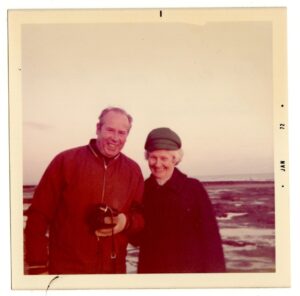
prior to being dead / sectioned, Pett Level, 1971.
Times Like These is a bit of gratuitous nonsense. It’s a good old-fashioned bit of rock and roll with a fairly meaningless and slightly dodgy bit of wordage that reflects very little in the real world beyond the insecurity the gnaws inside on the dark (most) days. No doubt Freud or Sharon would extrapolate way beyond what was actually intended.
I wrote this on the piano, and then transcribed to an organ voice. It’s still got a live sound to it because it was properly played rather than sequenced. But the key to this song is what Tush did to change it from a bit of bipperty-bopperty tat into a thumping track. That is why the mix puts his guitar right at the front where it belongs.
| Times Like These |
| It’s at times like these I need to know where I stand When I’m lying on top of you It’s at times like these I don’t understand When you say you love me is it true? Is it true, or am I stupid too? I can’t take this. I am being ignored. You can’t fake this. I am being paranoid. Do you love me? I don’t know if I can tell. I think I need you. Do you need me as well? Maybe I’m schizophrenic and you don’t see anyone else Maybe I’m just pathetic and you’ll love me just a little bit less Maybe you’re schizophrenic and you don’t see anyone else Maybe I’m just pathetic and you’ll love me just a little bit less It’s at times like these when you sound like you’re lying When you tell me that you’re having fun It’s at times like these that I can’t believe When you say I am the only one I’m being dumb |
Cautious is another work-related rant. I was still working with the company who had sponsored my degree, but the honeymoon period was well and truly over now. They’d cut at least a stone of flesh from me and were round every couple of weeks for a bit more.
I was curiously proud of our achievements within the organisation despite its countless ineptitudes. I was working in one division of this massive engineering company owned and jealously run by a certain Arnold Weinstock – a Leviathan of old school company management. Nobody bothered disagreeing with him, because he held all the ledgers, all the purse strings and most of the company shares. He bought and sold, took contracts he cared nothing about, milked governments for profit like he always had, and treated his staff like battery-livestock. Nobody worked there for recognition or reward. I rose quickly and learned quickly that I was being exploited just like everyone else.
| Cautious |
| Bob is earning peanuts working under me Bob has been here longer so he’s rich effectively Harold’s earning money for doing bugger all Bar drinking in the back room with back against the wall Arnold’s losing interest in the wake of cuts He’s investing in the papers, like the Queen of Cups Speaks only to the Yes Men and Bob is out of work Teletext more appealing than Bob losing his shirt Big Business, pile it high, cautious, cautious Simon is the holder of a million shares But Simon like his father seldom every dares To look beyond accountants To question money-sense And realise potential in a wealth of experience It’s the people who make the company It’s the people who make the sales It’s the people who make the progress It’s the people who tip the scales It’s the people who make the difference It’s the people who make it tall It’s the people who make the future It’s the people who are going to fall |
Writing this song in 3/4 was a kind of way of sticking two fingers up to established thinking, and limply to the organisation. Pop songs are very rarely written in this metre because it’s so easy to slip into that Viennese Waltz vibe. I think Cautious manages to avoid this by being consistently angry, stomping on the first beat of the bar so hard that it is effectively in 1 with a couple of ricochets rather than subordinate beats. When I put this song in front of Tush, he admitted he was at a bit of a loss and didn’t really know what to do with it. I suspect that the time signature had a lot to do with this confusion as there’s not a lot of 3/4 in Tush’s listening canon that isn’t a ballad. In the end he threaded whale noises throughout it like there was a version of Munch’s The Scream hiding just under the surface, and that worked fine.

Thirty years on, and now with computers and spreadsheets and databases and closing pay gaps and equity programmes and every other actual advancement, corporate indifference still makes me sick.
The opening piano riff of Ruby remains in the muscle memory of my fingers to this day. It is always ready to test the efficacy of any piano keyboard I come across. It’s a jolly little opening that belies the darkness of the tale that lies beyond the opening few bars.
I think this is inspired by a two-page short story lurking in the middle of an anthology on my mum’s bookshelf. She used to read quite a lot when younger, and this included pulp horror books. Being just around, they were accessible, and being a reasonably inquisitive youth, I dabbled. I recall choosing to read one particular story on the basis of its brevity, which in essence retold There Was An Old Lady Who Swallowed a Fly. It was of course a little more gruesome. In the story, the protagonist starts off by killing a fly and progresses through progressively bigger animals before their eyes alight on the spouse and cement mixer. It’s all over in a couple of pages. The text has clearly been formative.
I’ve juxtaposed the conclusion of this sorry tale of murderous progression into a “what if” scenario. I suspect the proximity of my grandparents’ death / incarceration may have subliminally influenced my wayward imagination, but there’s no need to call in Dr Freud and Sharon again. My two protagonists end alive and continue into their 41st year together. The title Ruby simply refers to the 40th wedding anniversary, and worked better than Gold, as it suggests it could have been one their names.
| Ruby |
| Together for forty years A house two kids and a dog Built in kitchen and a colour TV Twelve tune doorbell and a welcome mat She looked up at him and thought to herself Remembering all the bad times And in her mind’s eye she walked to the shed Came back with a scythe in her hand Struck down the man He looked up at her and thought to himself Remembering years of naggin And in his mind’s eye he reached for his tools And wired the sink to the mains That killed the pain Together for forty years Wedding album under the stairs An antique dresser dressed in Dalton China Her favourite being repaired She looked up at him and thought to herself Remembering hours of baking And in her mind’s eye she ground down a glass And worked it in his supper And watched the old man suffer He looked up at her and thought to himself Remembering bags of shopping And in his mind’s eye he took her silk scarf And came from behind like a ghost And closed it round her throat Together for forty years An Austin out on the drive Steradent and a glass of dentures Happy to be alive |

Another personal one.
Aunt Sally had a couple of boys. Russell, about my age, and Warwick, a couple of years younger. We saw each other occasionally as family friends do and got on well. The relationship actually came about because my Dad had worked with Sally’s Dad before I was born.
Now Warwick is a charmer, and an athlete. Much to his mum’s pride, he got himself a place to study at a US college on the basis of this athleticism, because he was a bit of a dab hand at football, as much as he was at tennis. So, like his Mum going to Africa at an early age, Warwick too flew off, and Russell and I went for a pint every so often in Tunbridge Wells.
On a vacation trip home for the summer, Warwick agreed to take part in a local football match for charity. The match was a semi-friendly game between the older players at the club (of which Warwick was now one) and the under-16 team. This was the club Warwick had grown up playing for and it caused a rumbling of excitement that he was turning out for the men’s team. During the match, a teammate went for Warwick, heading him instead of the ball: this clash of heads was for a ball that was not under challenge from an opposition player. Warwick had claimed the ball as his to deal with, but the teammate (one of the dads of another club player with whom Warwick had not always got along) ran from defence and headed Warwick on the temple rather than making contact with the ball. Warwick always maintained this was a malicious tackle after Warwick had admittedly been showing his new skills to all and the older player was someone with a reputation for crunching tackles and not yielding on the pitch. Warwick collapsed to the floor holding the side of his head but managed to finish playing the rest of the half. At half-time he decided he could not take any further part and applied a wet sponge to his head. After the match Warwick drove home, and with a banging headache took pain medication. Nobody at the club recognised at the time of the clash of heads that something was wrong, despite Warwick sitting out for the 2nd half.
A visit to a local pub followed but Warwick had to leave early due to the pains in his head caused by the ambient music. On arriving home, he sat down and felt knifing pains in his head. This was when he realised things were going badly wrong. He alerted Russell and an ambulance was called. At the local hospital the seriousness of the injury unfolded quickly. Warwick lost consciousness and went into a coma. He wouldn’t wake up again for nearly two months, and when he did, he was three hospitals downstream and could neither talk nor walk. These were injuries from which Warwick would never recover and he would now be permanently disabled, physically but not mentally.
Sally’s life stopped too. Her entire focus was Warwick’s mental recovery, in which we played a tiny part in her well organised visitors’ rota. It was challenging to watch the many months of hospital recovery while Warwick came to terms with the dramatic changes in his life; no longer being an athlete and having to take stock of what assets he still had. It must have been horrendous to be closer. But however trite it sounds, the unfair fall and rise story has left a massive imprint. My song is just a snapshot along that journey. Warwick is since married with kids and runs his own legal company. He continues to strive, 30+ years later, to stay fit but also to recover from his disability. Check him out, he’s a star:
https://www.headway.org.uk/about-brain-injury/individuals/brain-injury-and-me/warwick-jarvis

| Warwick |
| Learning to find his feet again When his feet were cut off at the neck Learning to find the man I once knew Lying in a hospital bed So suddenly just a shadow of the man that once was So easily from such an innocent cause His eyes open. Is he there or is it just a dream? Words spoken – heh I’m not what I seem And day by day he learned to take one step at a time And stage by stage he learned how to keep up the fight He learned not to give up the fight He’ll never let go of the fight He’s learning to find his feet again When his feet were cut off at the neck Learning to do all the things that he’d done Learning to be himself again |
Eloquent is another one of those practices for the classical-composer-me that would come later. Because of the M1 sequencer, this is so much tighter than what had been managed before: the basic structure and rhythmic framework of the whole track was set up and time-stabilised in that sequencer and this enabled me to then play the more interesting piano somewhat loosely over that framework without the timing going all over the place. Tush’s tremolos and glissandi were added after the fact with more emphasis on musicality and phrasing than on strict timing. As a consequence this works so much better as a piece of music.
Of course in the ideal world, we’d be able to replace all the dodgy synthesized voices that are emulating real instruments, with real instruments. This sort of thing has only just become a possibility as a result of both cheap and available CPU power in the home computer. At this point in 1995, I still had to overcome my resistance to acknowledging that my string playing was actually not only good enough – the combination of all its subtle imperfections would actually be better than relying on the accuracy of the synthesized equivalent. But that was going to take another twenty years.
Eloquent is understated and a whole lot better than I remember.
If It Were You not only uses the correct conjugation of the verb in the conditional, but it also concerns a matter of life and death.
I’d become increasingly opinionated about measuring life expectancy as the most important metric of a society’s health. I’d seen enough examples of forcibly keeping people alive to recognise that ethics of one size didn’t fit all. I recognised that imposing too simple a model based on an overly simple religious concept didn’t even work for the majority.
But it is complicated. There are vulnerable people who need safeguards and standing up for.
| If It Were You |
| If it were you lying on a bed of nails Feeling the last of your life drip away And if it weren’t for the pain, the sound would Drive you insane anyway If it were you feeling only the senses dull And you knew there was someone just out of reach Who had the power in his hands Could you ask him, would you ask him? If it were you looking at a bed of nails Watching the last of their life drip away And if you could hear again and again The sound of dying would drive you away And if you could see his life guttering slowly See the pain in his eyes just out of reach And if it were you with the power in your hands Would if he asked you Would if he asked you, turn off the switch? |
There was a glut of stories at the time that over-simplified the extremely complex issue of assisted death, into murder or not murder; stories that ignored context or compassion. They failed to consider that we needed a grown-up conversation to move us all forward. A conversation that includes but isn’t dominated by the ultra-conservatives because they don’t represent us. We’re still too scared to talk about this one in case we step out of line and get marked for it.

If It Were You is I think the best material on Utter. Its style stands it apart and makes the best use of the synth as a synth. I’m singing in major/minor seconds which is deliberately and thoroughly unsettling. Tush’s grungy guitar is supremely edgy. It is very effective and grimly closes this chapter without answering its own question.
The album closes with a final little rant about something else I couldn’t change, but clearly thought should be within the realms of feasibility. A few decades on and little has changed so looking back it’s perhaps a reflection of my youthful naivety. Penning Read All About It was prompted by the wall-to-wall tawdry coverage of some Royal or other’s marriage falling apart. I’m sure it’s very easy to say that the over-privileged few deserved everything that was coming, and that they should have read the small print when selling their soul for their fifteen minutes of fame / money / glory / whatever.
But whether they read it or not, they were still a person; our press was a drooling monster. The balance between genuine public interest and the voyeuristic mob it was feeding was lost a million years ago. The real truth is that everything is driven by revenue. But putting it starkly, the evil press only print it because we consume it. It was in physical newspapers then, and it’s now in ad-generating tweets and reels. Nothing has changed. We are still a mob of consumers at heart, and we still like a lynching.
I don’t agree with censorship per se, but just like everything else, we do need some rules of engagement. We agreed as a society to stop hanging on the village green a few centuries back and detox.
We still haven’t got this right and it’s important. Look to the superpowers for what happens when it gets worse.
| Read All About It |
| Why is it people still read the tabloids Why should we care if Miss X is a slut Why do we demand the rights of a pervert Who will crawl with a camera through two miles of mud Why do we need to debate liberty Why don’t we all get dressed out in the street Why do we bother to have a door on the bathroom Why should I be shy, I am no more than meat? Titillation, Fabrication Read all of about it you know it’s expected Read all about everybody’s secret lives Who has the right to slaughter happiness? Who has the right to split man and wife? Who has the right to kill love forever? Who has the choice how to live out their life? Why is it journalists are arrogant bastards? Who don’t give a damn if you’re guilty or not? How come our tabloids are sold as fun papers When they’re sold to make money regardless of hurt? Why do people pay for this garbage? Is it just eye-catching alliteration? What makes us reach out and pick a headline? Why can’t we change something when it is wrong? It is wrong. |
So, we’d captured all this music using the sequencer and the 4-Track. Chris had actually left university now, having finished his term and extra year as the Student Union President, and was doing a real job [sic] like the rest of us. The mixing and mastering of Utter needed something different because we didn’t have the access to the university studios that we’d always resorted to.
Well, time and indeed technology had moved on, and we had a smidge of spare hobby money, so we hired the means to mix and master everything over one exhausting weekend in my front room, to DAT – digital audio tape. This is essentially the same technology as a CD, but on an Incey-Wincey tape cassette. We hired loads of other fancy gubbins with the DAT machine to compress and level and reverberate and flange. I had recorded as much as I could “live”ish with the touch sensitive keyboard of the M1. Those new piano takes were captured in midi and we even faffed around a tiny bit to correct the odd bum note, religiously avoiding the application of the quantisation button.
The one thing we didn’t get right in spite of all these lovely new digital toys was Elaine’s voice. Fundamentally, the analogue recordings I had originally taken were technically of insufficient quality to sort out, and so they suffer in the mix. These days, I’d fess up and ask her to sing it again.