

03 – Sheer
| Steve Chowne | Vocals, Piano, Violin, Flute, Timps, Stuff in the Cupboard | Tush Hamilton | Guitars, Vocals, Stuff in the Cupboard | Robin Nagy | Tenor Sax, Stuff in the Cupboard |
| John ‘The Skell’ Fortis | Drum Programming | James Brown | The odd sample | Chris Green | Sound Engineering |
A quick historical context: This album is being created in 1991 – the year the Cold War ends, the Soviet Union collapses, and the world’s first ever website is established. Grunge and hip-hop are king, as is obvious from our third studio offering.
Graduation happened and we all drifted off into the infinite promises of adulthood and everything in the great wide world. Despite having worked in the unparalleled Portakabin complexes of Milton Keynes for the previous summers, I wasn’t quite prepared for the first two weeks spent in the shithole of a Gillingham hotel that my employer thought it was a good idea to offload me into. The hotel resembled something like Psycho in 70s brutalism, took practically all my income, and gave back nothing beyond guaranteed despair. It was grim, grimy and systemically antisocial. I checked out as fast as I could without compromising my bank balance and made arrangements to rent the outhouse behind Jason’s Mum and Dad down the road in Hollingbourne until we could afford our own place.
Jason’s Mum and Dad were an absolute delight to rent from. This may have been a short-term stopover, but they were so welcoming after that hotel from hell. I had privacy, warmth, TV and a kitchen. In return for splashing the hose around a bit whilst they went on holiday, I gained use of the extensive gardens to stroll around and chill in. I may not have quite realised it at the time, but the rent being taken was also very accommodating of my junior graduate income. Lovely people.

We bought our first house a few months later. This was a massively grown-up step, and another one of those enormous risks that normal people take in their stride. Looking the other way, I allowed myself to be guided. Good decision made, I moved into our own pad, our own mortgage, and the next stage of having no spare money whatsoever. We furnished our home with the old owners’ grey settee, a hand-me-down table and chairs, a one-burner Calorgas stove and a fridge. Our prized position however was the upright piano from my Mum and Dad’s house, which they had moved down to our place as I was the only one who played. So, a big empty cold grey house with a piano, a violin, a flute, a kettle and a microwave. There were a few spare rooms for inspiration and future instruments, but as yet, no money. When burgled, the only thing they took was a torch.
The rest of the band were gone, some as far as Russia, so this was a big reset. The Maidstone scene wasn’t encouraging, and I gave Tush a ring to see how things were. He was now at his Mum’s place in Orpington, despairing similarly of suburbia. Now I grew up in Croydon, so know a thing or two about the endless rows of 30s sprawl that is South London. However, even we in Croydon turned our grubby noses up at Orpington, with is tediously labyrinthine estates of bungalows that never end. Orpington – you’re either 90 or putting a pineapple in the porch.
I still had the Beetle. Tush was without wheels. It was only appropriate that I made the effort to drive up the M20 once a week to his place, which was oddly not a bungalow but a 70s townhouse. At his disposal we had his guitars and a small amp, his mum’s cooking, pen and paper, and that piano at which we first recorded Trigger Happy, still with its squeaky pedal. To this day, I still remember the dish of cabbage, sausage and potato that Tush’s Mum made for me, and have reproduced it hundreds of times over the last forty years. We know it in our house as Polish Cabbage Casserolein honour of its roots. Over the course of several months, we went to work during the day, and then on a Wednesday evening, we met and wrote the album Sheer the old-fashioned way: sitting together with piano and guitar, pen and paper, and working out chords, lyrics and structure.
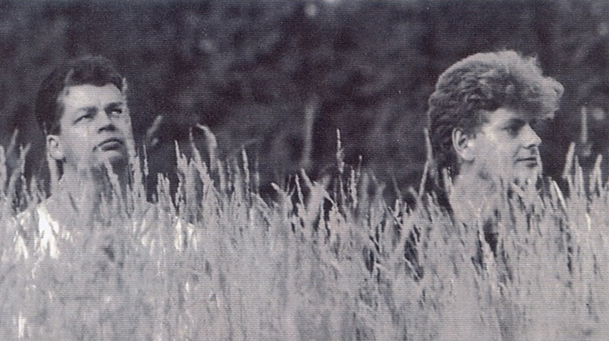
The opener, Does There Have To…? is absolutely a continuation of where we’d got to at the end of The Long, The Short and the Tall of It. Like pretty much everything on this album, its conception was a joint effort. The bulk of the lyric for this came from Tush, with me filling in the blanks as it went, but I don’t remember it being representative of any particular event or situation. Like much on this record, it’s probably a fair summary to categorise most of the harmonic structure as his, and most of the melody as mine, with a lot of overlap. In this retrospective, I find this quite interesting because we have very different approaches.
My background is largely classical. I learnt the violin, then the piano and then the flute. I played a lot of scales and did theory exams. Tush’s Mum encouraged him to learn the piano classically, but he rebelled and instead picked up the guitar, using his ears and innate musical talent to explore the art of the possible.
| Does There Have To … ? |
| Does there have to be a why? Be an answer plucked out of the sky Does there have to be a where and when? What’s wrong with a casual now and then? I can be delirious despite you being serious Quoting ambiguities to counter your insecurities Self-appealing platitudes and self-concealing attitudes If I can be myself why play someone else? In the face of love the world keeps spinning But I just walking bravely through Open my heart to a thousand women Just to keep from being true to you Does there have to be a how Does there have to be an answer right this moment now Does there have to be a plan Do I have to be your concept of a perfect man? You can be demanding, asking almost everything Quoting the man in your magazine smiling with his perfect sheen Your own ideas of how I should be instead of taking me for me If I can play myself, why play someone else? |
This gives us different perceptions and attitudes to what is essentially the same thing. It loosens (my) inhibitions and boundaries, and opens unobvious (to him) doors. This seems to apply to both harmonic structure and the development of counterpoint to this day. I’ll work it out on paper, looking for the progression that Bach would have done, whilst he’ll listen for the thing that sounds wrong or missing, and make it right. One of the consequences of Tush leading on harmony and structure on Sheer is that it is simpler than on most of the other Blue Powder albums. This is usually to the music’s benefit, because it’s consequently a better listen.
The second track, Downstairs, is kind of wishful thinking. It’s us putting ourselves into the imagined position of at least semi- success as a band; a world in which we are gigging and being listened to. It’s an
interesting reflection that whilst we were making music, it was private to us. Actually we needed someone to listen to it.
This needs setting in the context of the time. Plastic Surgery and The Long, The Short and The Tall of It were both committed to reel-to-reel tape, and then reproduced on short runs of compact cassettes that
we shared with our friends – private projects. Having now left the artificiality of university, that relatively safe space we had been playing in, we knew there was no audience now. There was no Battle of the Bands, no uni gigs, and no way to promote or distribute. We hadn’t really committed – and were just playing at being Downstairs in this made-up club.
| Downstairs |
| Downstairs, dingy by appearances Paper peeling off the walls Downstairs, aren’t we all? Downstairs, where the others are Waiting for us all to play Downstairs, hiding away Through the dusty air the first chord sounds its bell Through the smell of pungent smoke, urging the notes to swell Jazzy moods of ecstasy slide effortlessly higher While emotions in the fingertips purge the drinkers of desire Downstairs, we’re contended Sipping slowly the whiskey dry Downstairs, this is the life Downstairs, to the heart of me Blood of my love gently flows Downstairs, where I like to go Spinning in my carousel Waiter says it’s time to let go But we just keep on feeling and feeling Deeper and deeper inside Mapped the streets of everyone’s pain But I don’t want an easy way out We just keep on feeling deeper and deeper inside Downstairs, we’re contended Sipping slowly the whiskey dry Downstairs, this is the life Downstairs, to the heart of me Blood of my love gently flows Downstairs, where I like to go |
It’s nice and moody though, and I think reflects the idea rather well even if at the time the metaphor hadn’t actually been realised. Much later, after he had moved to the sunnier shores of Malaga, Tush would build his own man cave in which he lined the walls in posters, records and his now much broader array of instruments and recording kit. It would appear that this song is therefore genuinely prophetic … for we would go Downstairs to jam, write and record new material together in another time.
Birds do it. Bees do it. I know that actuaries do it. Even my better half was it at it five days a week and yet I couldn’t quite get it into my head why anyone would want to go into London on a daily basis. To choose a job that required a long and tedious, repetitively time-wasting commute was anathema. Of course, it’s relatively easy to have that opinion if you have an option not to. It was about ten years before the London commute was forced upon me by the employer, when I found myself doing the journey up to the West End every day. Never one to look a gift horse straight in the eyes, this seeded some great lyrical material for Accident and Emergency, but I’m getting ahead of myself. At this point, I could and even did sometimes cycle over the Kentish North Downs to the office at Rochester Airport. But even this provincial commute could be tedious; the airport site was home to about 7,000 staff, and with only one exit the impact on local traffic was so dramatic that they engineered a shifted work pattern to ease congestion on the roads. It sort of worked. As I sat in the inevitable queue, I was able to articulate my frustration with the words to Bored In The City – an ode to why local commuting was better than sitting on a train.
| Bored In The City |
| Look at all those who are bored in the city Little numbers rushing round and around Look at all those who are losing their rat-race Weeping faces getting lost in the crowd Black umbrellas, leather cases Grey raincoats and greyer faces Rats in the sewer and mice in a maze Bored in the city I’m lost in a daze Backstabbing, street fighting Litter in the gutter and dirty writing Bad buskers are signing the blue You better believe them cos they’re telling you the truth Got it coming, got it coming Everybody’s got to stop their gunning Money from the city has got its price Life’s too much of a sacrifice Bored in the city Bored it’s a pity What a waste of a life |
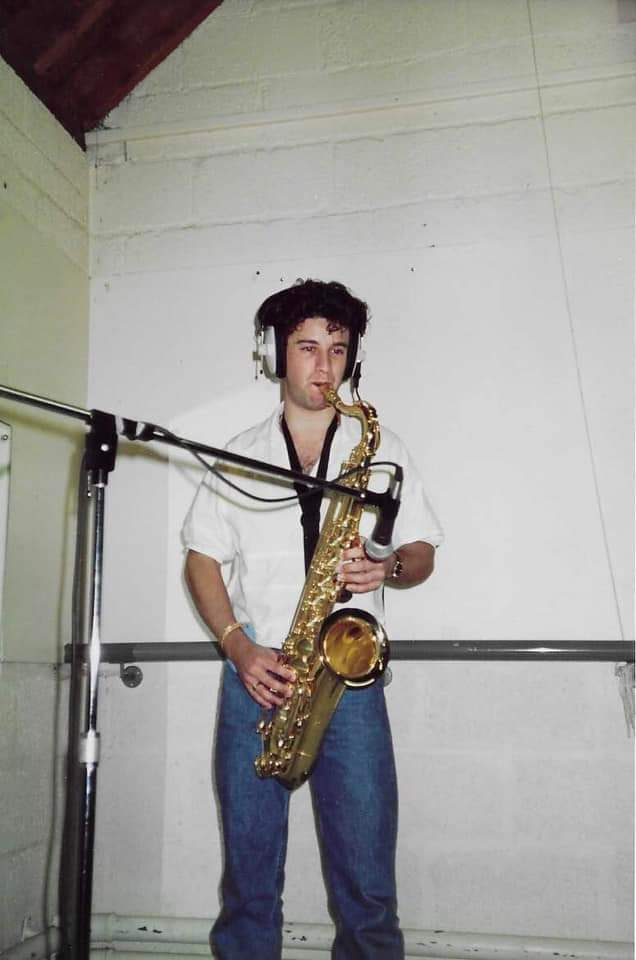
Limited by the lack of a real drummer, the implementation of this song is very much down to Tush twanging like a rock god, and me pretending likewise on vocals. The end result would have worked much better with a full backing band, but that’s what we had. We gave the seed of a solo line to Robin N who hammered it out on his tenorsax. That B natural is not a blues note, it’s a testament to the single live take we had time for, and we went with it.
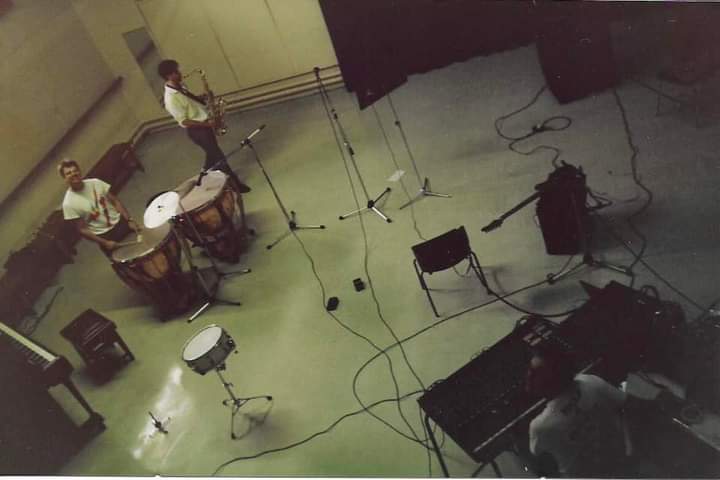
The entire Sheer album was in fact recorded in a single weekend at the Arts Barn on a weekend visit back to the university where Chris was still SU president. Tush, Robin N, Chris and I went back for just a couple of days, having booked out the space specifically for the job. Tush and I had prepared a few bits and bobs of backing on Freddy the 4-Track, still going strong, but almost everything was recorded in a first or second take in the one room over those two days. We had the usual piano, violin and flute, Tush’s guitars, rack and amps, Robin’s sax, our voices, and whatever we happened to find in the cupboard. The cupboard turned out to be a bit of a treasure trove of amusement, and we found to our delight a wealth of orchestral percussion instruments, including the shakers, tambourines, snare and timpani. Chris was thoroughly unamused by the timpani, expressing his profound dislike. It wasn’t enough to stop us playing though, which is why there is some odd percussion dotted around the album. On the up-side, the focussed rapid recording meant that there was more of a consistency of feel about the whole thing. On the down-side, the performance errors were captured for posterity and stayed in the edit; we had no time or means to do anything about them. This album has some good material, but it suffers badly from its underproduction, meaning its writing is not able to shine. That’s a shame, because after this record, the Hamilton-Chowne composition team would be separated by 1300 miles for a few years.
En Trance is clearly an opportunity for Tush and his guitar to show us more of what he’d learnt whilst in Spain. This underpins so many of our songs together in an understated way, so it’s only fitting there was an opportunity for him to take full centre stage here without any embellishment or ornamentation from me to distract.
The main lyric for Inside is Tush’s and I won’t pretend to be able to articulate what the meaning inside it is. Like Downstairs before it, we took this seed and developed it together. In this one, we started with two chords and his words for the verse, from which a tune popped into my head which we sang together in simple harmony to develop warmth as the verse progressed. This song develops in waves, with each wave progressing with slightly more energy until the last. I specifically recall the excitement of adding in that cymbal roll to link the progression from block to block, and then listening back and getting that all important spine-tingle when it came together that said it was working.
In the end, this is the song that probably has the best musicality on the whole of Sheer, and the most emotion. God knows what it’s going on about though.
| Inside |
| Looking down from above At this word we all love Picture frame, broken glass Without love, we won’t last It all starts coming out on the inside Oceans whisper in the night We all need a guiding light Just one hope, a guiding star Be it near, be it far It all starts coming out on the inside Take a look at what you find I hope it brings you a peace of mind I want a share in the love your stir me Lift away this coarse skin Tear apart my cynical chains See the heart the burns so freely Please take me away Slide your magic hands along The bones that cage me strongly Sense the tremors grow within Feel my spirit glowing Taste my lips, taste my mind, taste my soul Take me in, take me now, take me whole |
When I was a somewhat smaller person, my mum’s parents lived in a bungalow near a windmill on the
South Downs. In fact, you can see that windmill as you go down the A23 towards Brighton: having passed the 1930s pylons marking the entrance to the town (now city) boundaries, the main road south crosses the big east-west A27. Up on the hill on the right is that big old white windmill. Throughout my childhood, we would visit the grandparents on what would seem like most weekends. The roads were practically unrecognisable then compared to now, and I have an astonishing recollection of the route from Croydon to Brighton in the dark: all the landmarks that gave an indication of how much further there was to go. One such landmark of note was about halfway, in Bolney. No longer on the main road since the dual carriageway was built, there was a pub called the Queen’s Head, whose pub sign featured a most peculiar picture of Freddy Mercury (it’s since been
updated and I can’t find a pic).
Nowadays I am more likely to associate Bolney with some excellent English sparkling wine.
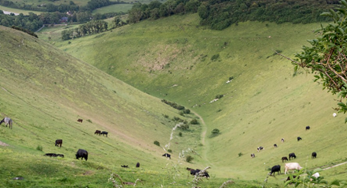
A couple of miles from the windmill is a curious geological feature in the Downs: a sort of long furrow that looks artificial. It’s a steep climb, and if you’re doing the South Downs Way on a bike, it’s frankly the last thing you want after half a day of cycling up and down and up and down. It is, however, beautiful. If you ignore the rather naff pub at the top, there are views to the north over the Weald, views to the south to the Channel, views east and west along the Downs, and views up and down the valley itself. It’s a great place to explore, and walk. Take muddy boots.

My grandfather told me the legend of the Devil’s Dyke and how it got its name. This is good old Sussex folklore and ideal material for the folk song that emerged in response to Tush warming up on two chords one evening. From those chords, I said… “just keep playing that”, which he did for 20 minutes whilst the whole song’s lyrics poured out. After all, I had heard the legend a great many times … I’m just passing it on in rhyme.
So, there’s this Devil, right? Bad guy that wants to flood the Weald. That’s the large bit of land between the North and South Downs. His evil plan was to dig a channel one night right through those big old South Downs all the way to the sea (presumably coming out at Shoreham, behind the power station). The legend of course puts some boundaries on his nefarious dodgy doings… it has to be completed in a single night or he’ll be found out.
So the Devil digs and digs and digs. He digs all night.
But just before dawn, just before he completes his canal of doom, a little old lady gets up for a wee or something (possibly my elaboration here). In order to see where she is going, she lights a candle, and holds it out in front of her as she moves around her tiny cottage.
The Devil is so busy with his task, he mistakes the little old lady’s innocent candle for the first glimmer of dawn, and he flees. The dyke is unfinished but remains testament to his bold designs of death and destruction. Behave, kids, or he’ll be back to finish the job.
| Devil’s Dyke |
| Looking out on a choppy sea With a sting in my eye from the salt on the breeze Kids flying high with their kite on the hill Looking down on the view with a thrill The Devil has a dugout that’s two miles long He’s a two mile shadow when the sun’s all but shone Kids going home with their dads and a grin And a lollipop stain on their innocent chin And the valley stretches out below The vestiges of daylight fade to a glow The Devil’s rising up inside Eight hours to make the tide And he forms in his hands of incredible size A spade that is twice as big as his lies He drops it to the ground as silently As an acorn grows into a tree With all his might he takes his first sod He’s as powerful as any other household god The night’s on his side as the black folds around him And the sweat on his brow falls into a spin And the valley stretches further on The Devil sings himself a song Witches are gathering on every side Four hours to make the tide Digging all night to the break of day And the valley stretches on the sea The Devil digs on incessantly His blistered hands are bleeding inside Two hours to make the tide Looking out on a shimmering sea With a tear in my eye and my laugh on the breeze Kids flying high as their kites on the hill Looking down on the view with a thrill The story goes on apparently That the Devil didn’t make it quite to the sea The dawn came early and he fled from the sight Of candlelight And the valley stretches up to the bend Where the Devil met his untimely end But he left us his prints to give us a sign He could be back to dig another time |
The twelve-minute instrumental that starts the second side of Sheer, Insha Allah, is foretaste of a composing direction to come. This really is my first foray into writing something of consequence. It’s possibly rhapsodic or fantastic in terms of structure, but could really be broken in four separate piano pieces that run together to make it one long piece. Amazingly, this was recorded in a single take on a real piano, with no click track or editing. That explains why the timekeeping is a bit random in places, and our attempts to subsequently embellish the basic piano with bells and whistles (or rather, whatever we found in the cupboard) is not particularly well aligned. It is what it is, and with modern technology and multitracking, it would sound a whole lot tidier and easier to listen to.
Insha Allah, or God Willing, was really rather flawed, but it gave me sufficient confidence to keep going. Compositionally, it leads directly to the last track on Accident and Emergency and, albeit many many years later, the confidence to pen an actual piano concerto. And for that, I do not apologise.
Ensconced in my house in Maidstone in the winter of 1990, I was starting to explore gardening. I had a tiny garden and no money, so the exploration was extremely modest. However, everyone can afford to put in a handful of daffodils. That is what I was doing in our very modest front patch, when, once again, it started to snow from a clear blue sky. There was of course a precedence (see tracklist of Out In The Air), so I set about writing the song.
This one started with the piano and lyrics and was very centred on the flashy glissando runs. It was fully formed until I took it to Tush the following Wednesday, when he added a completely orthogonal layer that immediately gave it so much more body and substance. This was interesting: both parts, his and mine remain pretty intact and complement without diminishing the other. I love it when that happens.
It’s clear that even though I was working very much in civil aviation at the time, this song is picking up where Making Paper Planes left off. This is clearly unfinished business, although I note it hasn’t taken off in Iran as yet.
| Daffodils |
| Diggin trenches in the sun For the chance to hold a gun everybody’s ignoring me It’s no surprise I’m planting daffodils in the snow For the chance to watch them grow Everybody is watching me It’s no surprise, it’s in my eyes It’s no surprise I fantasise Sometimes deep in the heart It’s quiet so nob-one else can hear The rhythmic beat so loud The rhythmic beat so effortlessly clear It’s calling your to rise It’s calling you to sympathise It’s calling you to shout out the man Who’s obviously madder than I am My daffodils are rising all around me Flowering out my every pore The perfume of so overpowering Calling me to go out to war It’s not me I didn’t plan this It’s not me I don’t want to know Not me, I won’t be a part of it Not me, I’m not going to go |
Having got engaged at uni and now bought our house together, our actual wedding was getting closer. We would marry the next year back in Croydon, and we were clearly focussing a great deal of time and effort in the planning and preparation of our special event. It was clearly on my mind in songwriting too.
The lyrics to All That I Am paraphrase the wedding service vows – at this time you had a choice of marriage in a registry office or church/synagogue/mosque etc. The choices available have opened up significantly since both in terms of service and location but it was somewhat simpler then: you either did it this way, or you didn’t get married. We’d chosen the church we’d been taken to in our youth, and so had been required to attend a number of classes in readiness, at which we’d become quite familiar with the vows and what they meant.
| All That I Am |
| All that I am I give you All that I could be All that I feel I share with you All that I is we All the sun, all the rain, all the feelings, all the day All the memories, all the joy All the best, all the worst, all the hunger, all the thirst All the trouble, all the pain, all the whiskey and the shame All the future, all the past, all the good times here to last All the day, all the dusk, all the loving, all the lust |
The closer on Sheer is testament to the idea that white blokes shouldn’t rap, even in jest. I think we knew that even before we started. I think it’s probably justice that the distributors throw this track out because of the unlicensed James Brown samples.
| There Must Be Fifty Ways To Catch The Attention Of A Policeman |
| There must be fifty ways to attract the attention of a policeman No 1 way to get his notice is to walk up to him and say: “hello there, Howdy Bobby”, even if his name is Joseph. Slap on the back and then call him Dick. I am sure I can improve on the method of attraction Of my friendly local copper when he’s out of the beat By shouting “Help, Fire, Rape” when he’s in my location He’ll come screaming round the corner To see what I need Ask the man the round to follow up on a break-in Sit him right down with a scalding cup of tea Tell the man he’s balding, his bad breath is quiet appalling, And he shouldn’t ride his bike because it gives him backwards knees Ring 999 on the phone and ask the lady If she’s got a spare man who can come your way Throw a brick or a bottle through the window of his panda Jump behind the wheel and drive it away Steal the man’s hat and then put it in the garden With some cannabis seeds growing under the rim Hold a party with the music really funky loud and groovy The sort of party that there’s never ever been Shoot your wife, shoot your mother, kill the job, kill your brother These are the ways of getting him to turn around Eat his cat, stuff his budgie, screw his wife, smother his granny Steal his false teeth and hide them underground In a private investigation when it feels like an invasion When you hear the kids are crying and your grandmother is sighing You hear them talk of freedom but cannot believe them And they kick you till you’re bleeding and feel your brains are spilling And he offers you an attorney but I ain’t going on no journey Cos my mind is on the carpet and my head is in the bucket |
We were about to go our separate ways.